The Teesside Photographer
Middlesbrough Iron
A colour grade built from the rock under the town. Every photograph treated with it is tinted, shadow to highlight, by the layers of ironstone that made Middlesbrough exist.
A 3D LUT derived from the stratigraphy of the Cleveland Ironstone Formation. The tonal axis of the image is mapped onto the geological column: the deepest strata colour the shadows, the weathered outcrop colours the highlights.
What is a LUT?
A LUT — a “look-up table” — is a colour recipe. For every colour a camera can record, the table holds a replacement: this exact blue becomes that slightly greener blue, this grey warms towards rust. Apply the table to a photograph and every pixel is swapped for its listed replacement, all at once.
It is how films get their consistent look. The decisions are made once, written into the table, and then applied identically to every image.
Middlesbrough Iron is a 3D LUT: a 33×33×33 lattice spanning the RGB cube, stored as an IRIDAS .cube file — 35,937 sampled points, each holding the output colour for one input colour. Colours between lattice points are found by trilinear interpolation, so the transform is smooth everywhere.
Unlike a 1D curve, a 3D LUT can move colour and tone together and differently in different regions of the cube — which is what lets a geological column, with a different cast per brightness band, be written as a single transform. It loads in Affinity Photo as a LUT adjustment layer and applies non-destructively.
The rock
About 190 million years ago, Teesside was a shallow sea. Its bed — mud, and seams of iron-rich stone — hardened into the layered rock that now runs through the Eston Hills. In 1850 the thickest seam was opened at Eston, and within a generation a farmhouse hamlet on the Tees had become an iron town supplying the world. Middlesbrough exists because of these layers.
Fresh ironstone is a surprising green-grey. Left in the weather it rusts to the familiar orange-brown. The rock itself runs the whole palette of this grade.
The Cleveland Ironstone Formation — Lower Jurassic, Pliensbachian, Lias Group — is a sequence of marine mudstones carrying workable ironstone seams, mined in ascending order as the Avicula, Raisdale, Two Foot, Pecten and Main seams. The ore is oolitic: ooids of berthierine (chamosite) set in a siderite matrix — green-grey when fresh-broken, oxidising at outcrop to goethite and limonite rust.
The Main Seam, up to ~3 m thick at Eston, is the founding seam: traced to outcrop by Vaughan and Marley in 1850, it fed Bolckow & Vaughan’s furnaces and built the town. Below the seams sit unweathered pyritic shales, cold and blue-grey — the bottom of the column, and of the grade.
The column, stood on end
The grade reads a photograph as if it were the rock face. The darkest parts of the image are treated as the deepest strata; the brightest parts as the weathered surface and the sky above it. Each rock layer tints its own band of brightness — cold blue-grey in the deep shadows, green-grey in the low tones, turning to rust in the midtones, fading to pale ochre near white.
So the geological column is stood on end inside every image: to climb from shadow to highlight is to climb the seam.
The tonal axis is the stratigraphic column. Eight anchors — a luminance centre and an RGB cast offset per stratum — are linearly interpolated across the range, so every luma level inherits a blend of the strata either side of it. Luma is computed as Rec.709.
Two protections keep it photographic: casts are weighted toward the ends of the range so pure black and white stay clean, and they scale inversely with the pixel’s own chroma — the seam colours the stone, not the sky. A separate tone curve acts on luminance only: a gentle S with a Fuji-style shoulder, blacks held down (the unlit seam), highlights capped at 0.965 — nothing at Eston reads pure white. Global saturation sits at 0.90, the mudstone greyness the seams are bedded in.
Shadow to highlight, seam by seam
Swatches are exaggerated for legibility — in the LUT each cast is a few percent.
What you’re seeing
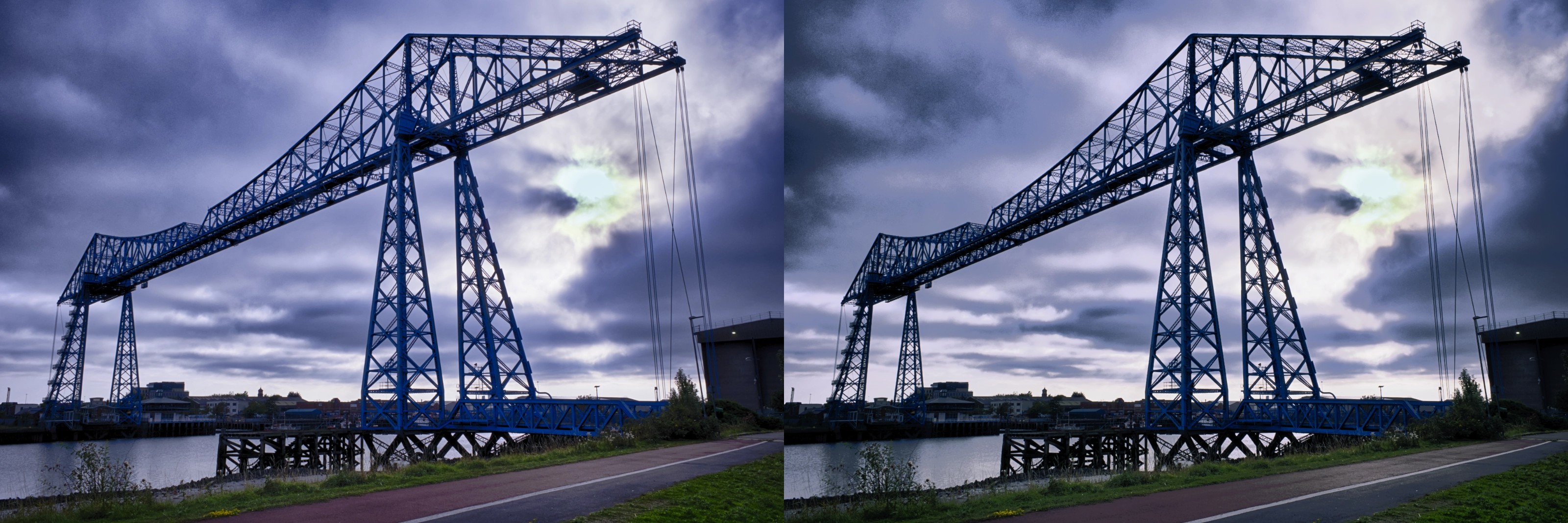
Transporter Bridge · original left, graded right
The graded frame looks like the same scene remembered through iron. Shadows cool and green slightly; the middle of the picture — steelwork, brick, road — warms toward rust; the sky stays close to its own colour; and nothing reaches pure white, so the whole image sits a half-step behind full brightness, like weathered metal.
The blue steelwork keeps its hue — its chroma suppresses the cast — while the near-neutral girder shadows pick up the Raisdale green-grey. The midtone push is where the grade declares itself: goethite warmth across the deck and the far bank, exactly the band the Main Seam occupies. The shoulder is visible in the sky: highlight rolloff to a capped, faintly warm near-white rather than paper white.
Colour and mono
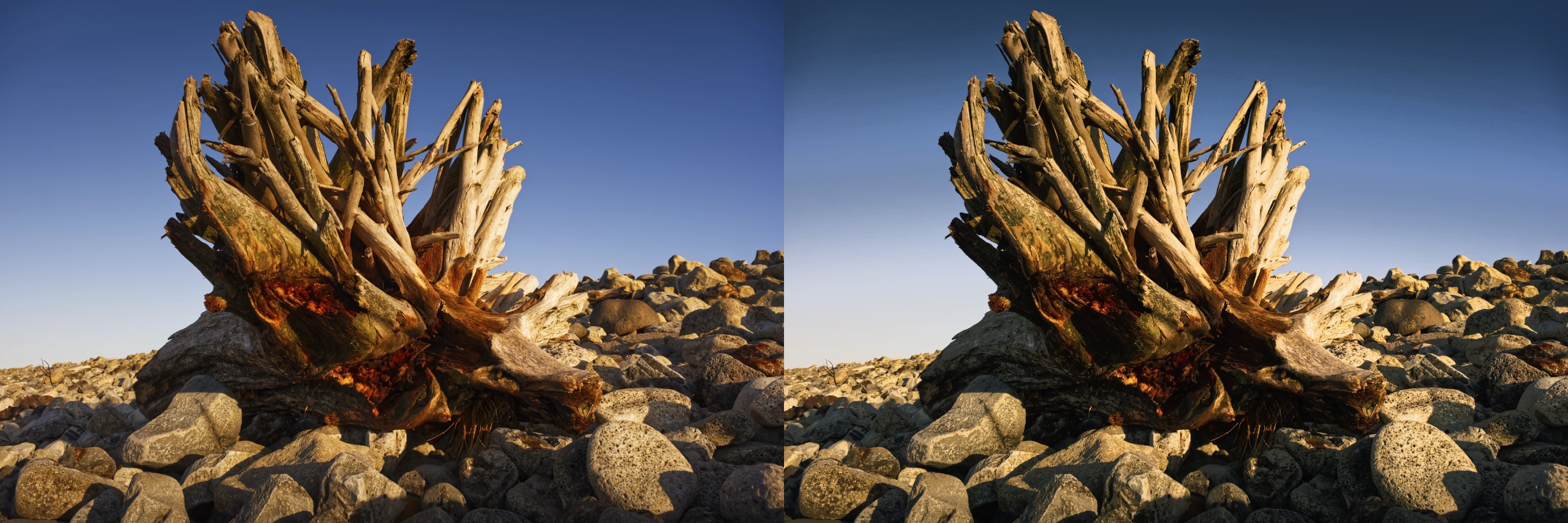
South Gare driftwood · original left, graded right

Temenos, monochrome · original left, graded right
On a monochrome image the grade shows itself most clearly: with no colour of its own, the picture takes the column’s — cool grey-green shadows, rust-warmed midtones, pale warm highlights.
On mono the LUT reads as a geological split-tone: since every pixel is neutral, the chroma protection never engages and each luma band takes its full cast. The column is visible with no subject colour in the frame at all.
Notes
The grade is written once, as a file, and applied identically to every photograph in the series — the same discipline as shooting a single film stock. All images made on Teesside; the rock the grade is built from is the rock under the photographs.
Generated by a small Python script: strata anchors → cast interpolation → luminance-only tone curve → 33³ .cube. Applied in Affinity Photo as the first grading step on RAW frames from a Fujifilm X-T5. In-camera approximation for live preview: Classic Chrome, WB shift R+1 B−2, highlight −1 — but the .cube is the score; Affinity is the performance.